
Nephrotoxicity and Drug Interaction Study Using a Human Proximal Tubule-On-A-Chip
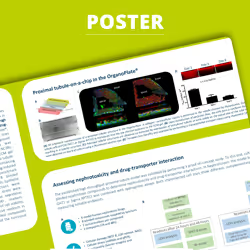
Drug-induced kidney injury (DIKI) poses a risk to renal proximal tubules, potentially resulting in kidney failure and acting as a limiting factor in pharmacotherapy. DIKI is responsible for causing 14-26% of acute kidney injury cases, highlighting its significance in clinical settings. This stark contrast emphasizes the urgent requirement for improved predictive models to assess nephrotoxicity during the discovery and early development of drugs.In this poster, we present a high throughput, standardized and automatable OrganoPlate® platform for the detection of drug-induced nephrotoxicity. The OrganoPlate® 3-lane was combined with renal proximal tubule epithelial cell lines (RPTEC) and exposed to fluid shear stress. Additionally, this model was exposed to known and blinded nephrotoxic compounds to explore nephrotoxicity and drug-transporter interactions. we present a 3D microfluidic primary human brain microvascular endothelial cell (HBMEC) BBB model with relevant junction and transporter expression, tight and selectively permeable barriers, response to known toxicants, and suitability for high-throughput, on-chip TEER measurements.
Nephrotoxicity and Drug Interaction Study Using a Human Proximal Tubule-On-A-Chip
Nephrotoxicity and Drug Interaction Study Using a Human Proximal Tubule-On-A-Chip
A high-throughput proximal tubule-on-a-chip model using RPTEC cells and fluid flow to evaluate drug-induced nephrotoxicity and transporter interactions—offering a predictive, automatable platform for early-stage kidney safety assessment.
Nephrotoxicity and Drug Interaction Study Using a Human Proximal Tubule-On-A-Chip
A high-throughput proximal tubule-on-a-chip model using RPTEC cells and fluid flow to evaluate drug-induced nephrotoxicity and transporter interactions—offering a predictive, automatable platform for early-stage kidney safety assessment.
Nephrotoxicity and Drug Interaction Study Using a Human Proximal Tubule-On-A-Chip
A high-throughput proximal tubule-on-a-chip model using RPTEC cells and fluid flow to evaluate drug-induced nephrotoxicity and transporter interactions—offering a predictive, automatable platform for early-stage kidney safety assessment.
Nephrotoxicity and Drug Interaction Study Using a Human Proximal Tubule-On-A-Chip
A high-throughput proximal tubule-on-a-chip model using RPTEC cells and fluid flow to evaluate drug-induced nephrotoxicity and transporter interactions—offering a predictive, automatable platform for early-stage kidney safety assessment.
Nephrotoxicity and Drug Interaction Study Using a Human Proximal Tubule-On-A-Chip
A high-throughput proximal tubule-on-a-chip model using RPTEC cells and fluid flow to evaluate drug-induced nephrotoxicity and transporter interactions—offering a predictive, automatable platform for early-stage kidney safety assessment.
Nephrotoxicity and Drug Interaction Study Using a Human Proximal Tubule-On-A-Chip
A high-throughput proximal tubule-on-a-chip model using RPTEC cells and fluid flow to evaluate drug-induced nephrotoxicity and transporter interactions—offering a predictive, automatable platform for early-stage kidney safety assessment.
Nephrotoxicity and Drug Interaction Study Using a Human Proximal Tubule-On-A-Chip
A high-throughput proximal tubule-on-a-chip model using RPTEC cells and fluid flow to evaluate drug-induced nephrotoxicity and transporter interactions—offering a predictive, automatable platform for early-stage kidney safety assessment.
Nephrotoxicity and Drug Interaction Study Using a Human Proximal Tubule-On-A-Chip
A high-throughput proximal tubule-on-a-chip model using RPTEC cells and fluid flow to evaluate drug-induced nephrotoxicity and transporter interactions—offering a predictive, automatable platform for early-stage kidney safety assessment.