
Opportunities in Toxicity Testing of New Drug Modalities with 3D in vitro Models
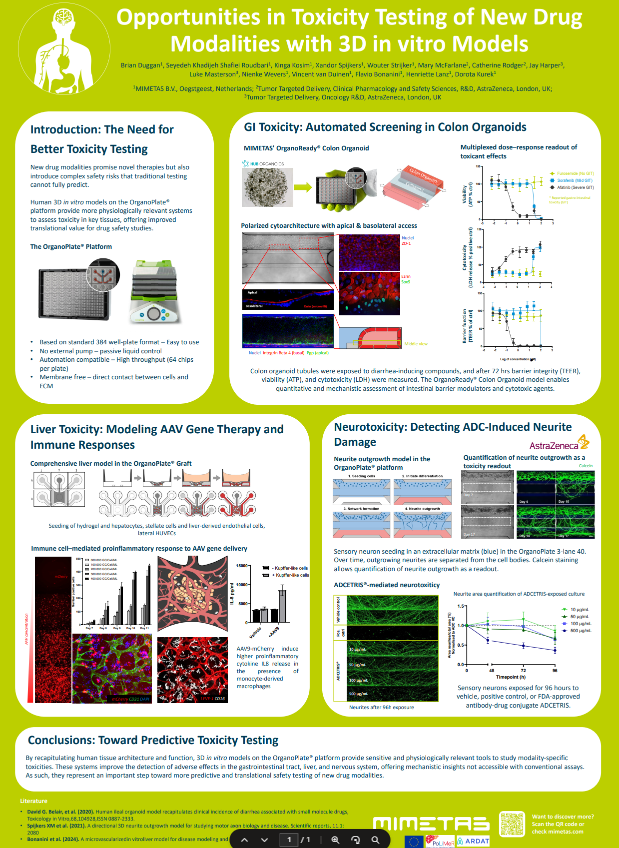
OrganoPlate® platform advantages: Standard plate format, no external pumps (passive liquid control), automation-compatible high throughput, and membrane-free cell–ECM interactions.
Poster highlights
- GI toxicity screening in colon organoids (OrganoReady®): Automated, quantitative assessment of diarrhea-inducing compounds using multiplexed dose–response readouts.
- Multi-parameter GI readouts: Barrier integrity (TEER), viability (ATP), and cytotoxicity (LDH) measured after exposure (e.g., compounds with reported GI toxicity ranging from none to severe).
- Liver toxicity + immune response modeling (AAV): A comprehensive liver model used to assess immune cell–mediated proinflammatory response to AAV gene delivery, including IL-8 release signals.
- Neurotoxicity detection (ADC): A neurite outgrowth model enabling quantification of ADC-induced neurite damage over time (neurite area as a toxicity readout).
Key takeaway: 3D in vitro models can deliver more predictive and mechanistic insights across tissues—supporting translational safety testing for next-generation therapeutics.
Opportunities in Toxicity Testing of New Drug Modalities with 3D in vitro Models
Opportunities in Toxicity Testing of New Drug Modalities with 3D in vitro Models
Discover how human 3D in vitro models can strengthen safety assessment for emerging drug modalities. In this poster, we highlight OrganoPlate®-based assays for GI toxicity, liver inflammation linked to AAV gene delivery, and ADC-induced neurotoxicity—combining physiological relevance with automation-compatible throughput. OrganoPlate® platform advantages: Standard plate format, no external pumps (passive liquid control), automation-compatible high throughput, and membrane-free cell–ECM interactions.
Opportunities in Toxicity Testing of New Drug Modalities with 3D in vitro Models
Discover how human 3D in vitro models can strengthen safety assessment for emerging drug modalities. In this poster, we highlight OrganoPlate®-based assays for GI toxicity, liver inflammation linked to AAV gene delivery, and ADC-induced neurotoxicity—combining physiological relevance with automation-compatible throughput. OrganoPlate® platform advantages: Standard plate format, no external pumps (passive liquid control), automation-compatible high throughput, and membrane-free cell–ECM interactions.
Opportunities in Toxicity Testing of New Drug Modalities with 3D in vitro Models
Discover how human 3D in vitro models can strengthen safety assessment for emerging drug modalities. In this poster, we highlight OrganoPlate®-based assays for GI toxicity, liver inflammation linked to AAV gene delivery, and ADC-induced neurotoxicity—combining physiological relevance with automation-compatible throughput. OrganoPlate® platform advantages: Standard plate format, no external pumps (passive liquid control), automation-compatible high throughput, and membrane-free cell–ECM interactions.
Opportunities in Toxicity Testing of New Drug Modalities with 3D in vitro Models
Discover how human 3D in vitro models can strengthen safety assessment for emerging drug modalities. In this poster, we highlight OrganoPlate®-based assays for GI toxicity, liver inflammation linked to AAV gene delivery, and ADC-induced neurotoxicity—combining physiological relevance with automation-compatible throughput. OrganoPlate® platform advantages: Standard plate format, no external pumps (passive liquid control), automation-compatible high throughput, and membrane-free cell–ECM interactions.
Opportunities in Toxicity Testing of New Drug Modalities with 3D in vitro Models
Discover how human 3D in vitro models can strengthen safety assessment for emerging drug modalities. In this poster, we highlight OrganoPlate®-based assays for GI toxicity, liver inflammation linked to AAV gene delivery, and ADC-induced neurotoxicity—combining physiological relevance with automation-compatible throughput. OrganoPlate® platform advantages: Standard plate format, no external pumps (passive liquid control), automation-compatible high throughput, and membrane-free cell–ECM interactions.
Opportunities in Toxicity Testing of New Drug Modalities with 3D in vitro Models
Discover how human 3D in vitro models can strengthen safety assessment for emerging drug modalities. In this poster, we highlight OrganoPlate®-based assays for GI toxicity, liver inflammation linked to AAV gene delivery, and ADC-induced neurotoxicity—combining physiological relevance with automation-compatible throughput. OrganoPlate® platform advantages: Standard plate format, no external pumps (passive liquid control), automation-compatible high throughput, and membrane-free cell–ECM interactions.
Opportunities in Toxicity Testing of New Drug Modalities with 3D in vitro Models
Discover how human 3D in vitro models can strengthen safety assessment for emerging drug modalities. In this poster, we highlight OrganoPlate®-based assays for GI toxicity, liver inflammation linked to AAV gene delivery, and ADC-induced neurotoxicity—combining physiological relevance with automation-compatible throughput. OrganoPlate® platform advantages: Standard plate format, no external pumps (passive liquid control), automation-compatible high throughput, and membrane-free cell–ECM interactions.
Opportunities in Toxicity Testing of New Drug Modalities with 3D in vitro Models
Discover how human 3D in vitro models can strengthen safety assessment for emerging drug modalities. In this poster, we highlight OrganoPlate®-based assays for GI toxicity, liver inflammation linked to AAV gene delivery, and ADC-induced neurotoxicity—combining physiological relevance with automation-compatible throughput. OrganoPlate® platform advantages: Standard plate format, no external pumps (passive liquid control), automation-compatible high throughput, and membrane-free cell–ECM interactions.