
Functional ADME-Tox Testing with OrganoReady® Colon Organoid: Multimodal Assessment of Drug Transport and Metabolic Enzymes
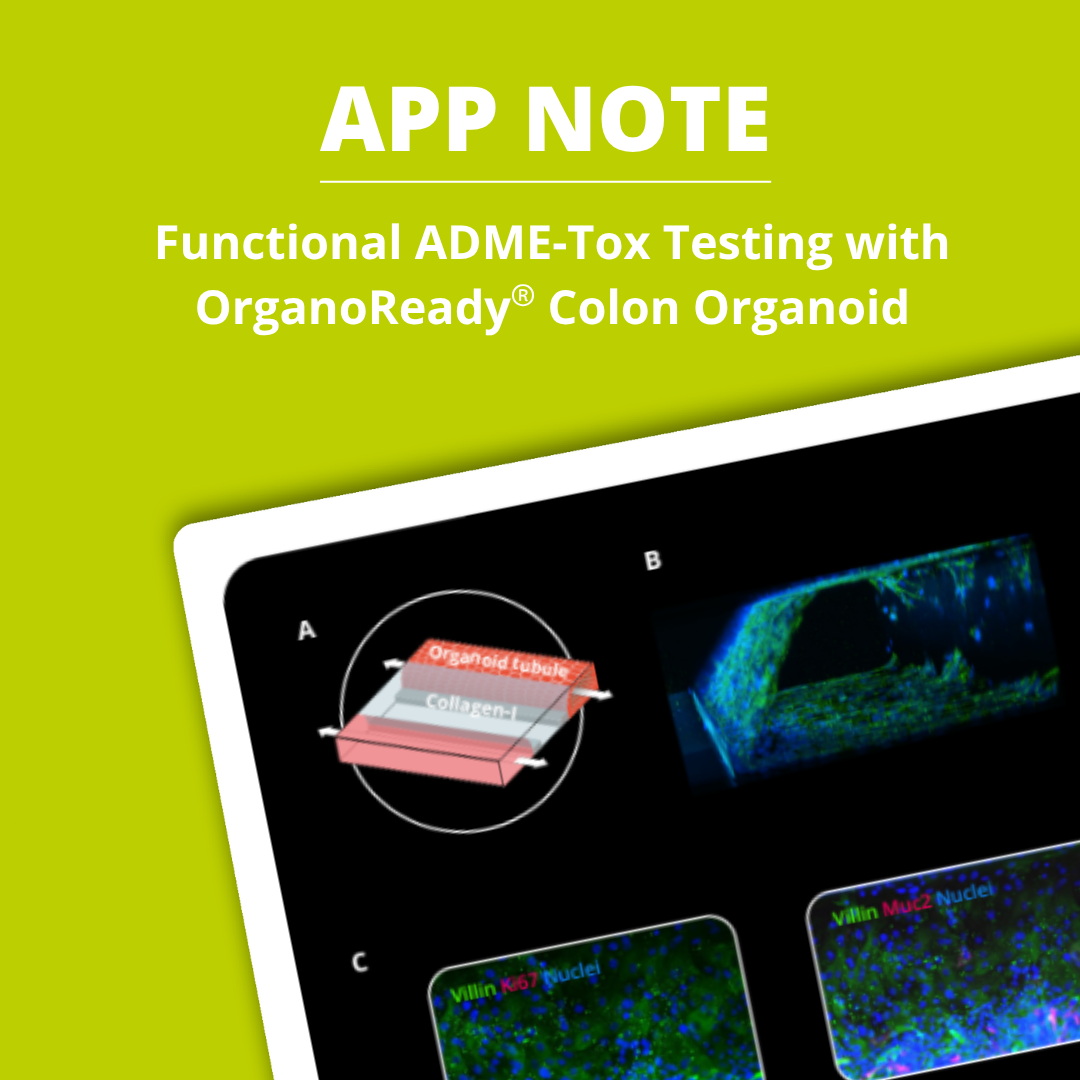
Accurate prediction of drug absorption, metabolism, and toxicity (ADME/Tox) is essential for successful drug development. The intestinal epithelium plays a central role in regulating systemic drug exposure - but conventional 2D cell lines and static inserts fail to replicate its physiological complexity.
This application note demonstrates how MIMETAS’ OrganoReady® Colon Organoid model overcomes these limitations. Derived from human adult stem cells and cultured in the OrganoPlate® 3-lane microfluidic platform, this 3D system recreates the architecture and function of the human colon epithelium under dynamic flow conditions.
Functional ADME-Tox Testing with OrganoReady® Colon Organoid: Multimodal Assessment of Drug Transport and Metabolic Enzymes
Functional ADME-Tox Testing with OrganoReady® Colon Organoid: Multimodal Assessment of Drug Transport and Metabolic Enzymes
This application note showcases how the OrganoReady® Colon Organoid enables more predictive ADME/Tox testing by combining 3D human tissue architecture with dynamic flow. It supports accurate assessment of drug transport and metabolic activity beyond conventional in vitro models.
Functional ADME-Tox Testing with OrganoReady® Colon Organoid: Multimodal Assessment of Drug Transport and Metabolic Enzymes
This application note showcases how the OrganoReady® Colon Organoid enables more predictive ADME/Tox testing by combining 3D human tissue architecture with dynamic flow. It supports accurate assessment of drug transport and metabolic activity beyond conventional in vitro models.
Functional ADME-Tox Testing with OrganoReady® Colon Organoid: Multimodal Assessment of Drug Transport and Metabolic Enzymes
This application note showcases how the OrganoReady® Colon Organoid enables more predictive ADME/Tox testing by combining 3D human tissue architecture with dynamic flow. It supports accurate assessment of drug transport and metabolic activity beyond conventional in vitro models.
Functional ADME-Tox Testing with OrganoReady® Colon Organoid: Multimodal Assessment of Drug Transport and Metabolic Enzymes
This application note showcases how the OrganoReady® Colon Organoid enables more predictive ADME/Tox testing by combining 3D human tissue architecture with dynamic flow. It supports accurate assessment of drug transport and metabolic activity beyond conventional in vitro models.
Functional ADME-Tox Testing with OrganoReady® Colon Organoid: Multimodal Assessment of Drug Transport and Metabolic Enzymes
This application note showcases how the OrganoReady® Colon Organoid enables more predictive ADME/Tox testing by combining 3D human tissue architecture with dynamic flow. It supports accurate assessment of drug transport and metabolic activity beyond conventional in vitro models.
Functional ADME-Tox Testing with OrganoReady® Colon Organoid: Multimodal Assessment of Drug Transport and Metabolic Enzymes
This application note showcases how the OrganoReady® Colon Organoid enables more predictive ADME/Tox testing by combining 3D human tissue architecture with dynamic flow. It supports accurate assessment of drug transport and metabolic activity beyond conventional in vitro models.
Functional ADME-Tox Testing with OrganoReady® Colon Organoid: Multimodal Assessment of Drug Transport and Metabolic Enzymes
This application note showcases how the OrganoReady® Colon Organoid enables more predictive ADME/Tox testing by combining 3D human tissue architecture with dynamic flow. It supports accurate assessment of drug transport and metabolic activity beyond conventional in vitro models.
Functional ADME-Tox Testing with OrganoReady® Colon Organoid: Multimodal Assessment of Drug Transport and Metabolic Enzymes
This application note showcases how the OrganoReady® Colon Organoid enables more predictive ADME/Tox testing by combining 3D human tissue architecture with dynamic flow. It supports accurate assessment of drug transport and metabolic activity beyond conventional in vitro models.