
A Ready-To-Use Model for Scalable Assessment of Endothelial Toxicity and Immune Activation
Poster highlights
- Ready-to-use 3D microvessels: 64 perfusable HUVEC-derived tubules with apical and basal access, delivered pre-cultured and assay-ready on the OrganoPlate® platform.
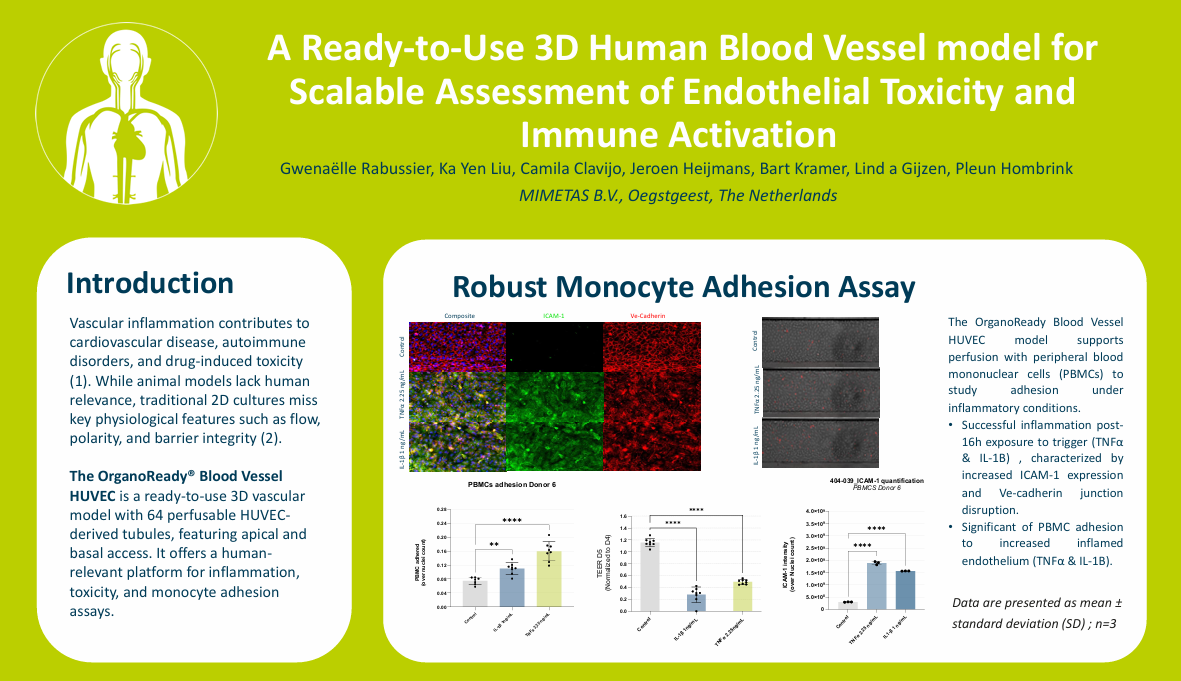
- Robust inflammation + injury assay panel: Readouts include barrier integrity (TEER), ICAM-1 expression, and monocyte/PBMC adhesion to quantify endothelial activation and dysfunction.
- Cytokine-triggered endothelial activation: Inflammatory stimulation (e.g., TNFα, IL‑1β, TNFα + IFNγ) drives dose-dependent ICAM‑1 upregulation and junction changes (VE-cadherin disruption).
- Immune cell perfusion + adhesion readouts: Perfusion with PBMCs enables reproducible measurement of adhesion under inflammatory conditions—linking endothelial activation to functional immune interactions.
- Drug-induced vascular toxicity profiling: Doxorubicin produces a dose-dependent toxicity profile captured via real-time OrganoTEER® measurements (barrier disruption at higher doses).
- Reproducibility + logistics: TEER data show consistent barrier integrity between in-house vs shipped OrganoReady cultures—supporting scalable workflows.
Where it fits: Enables preclinical researchrelevant to atherosclerosis, diabetes, and ischemia-reperfusion injury,and supports evaluation of vascular liability for new therapeutics.
A Ready-To-Use Model for Scalable Assessment of Endothelial Toxicity and Immune Activation
A Ready-To-Use Model for Scalable Assessment of Endothelial Toxicity and Immune Activation
Vascular inflammation contributes to cardiovascular disease, autoimmune disorders, and drug-induced toxicity; 2D cultures and animal models often lack key human-relevant physiology. Download the poster to see how a ready-to-use 3D human blood vessel model enables robust, scalable readouts of endothelial inflammation, barrier disruption, and immune cell adhesion—supporting drug-induced vascular toxicity testing and preclinical research in cardiovascular and inflammatory disease areas.
A Ready-To-Use Model for Scalable Assessment of Endothelial Toxicity and Immune Activation
Vascular inflammation contributes to cardiovascular disease, autoimmune disorders, and drug-induced toxicity; 2D cultures and animal models often lack key human-relevant physiology. Download the poster to see how a ready-to-use 3D human blood vessel model enables robust, scalable readouts of endothelial inflammation, barrier disruption, and immune cell adhesion—supporting drug-induced vascular toxicity testing and preclinical research in cardiovascular and inflammatory disease areas.
A Ready-To-Use Model for Scalable Assessment of Endothelial Toxicity and Immune Activation
Vascular inflammation contributes to cardiovascular disease, autoimmune disorders, and drug-induced toxicity; 2D cultures and animal models often lack key human-relevant physiology. Download the poster to see how a ready-to-use 3D human blood vessel model enables robust, scalable readouts of endothelial inflammation, barrier disruption, and immune cell adhesion—supporting drug-induced vascular toxicity testing and preclinical research in cardiovascular and inflammatory disease areas.
A Ready-To-Use Model for Scalable Assessment of Endothelial Toxicity and Immune Activation
Vascular inflammation contributes to cardiovascular disease, autoimmune disorders, and drug-induced toxicity; 2D cultures and animal models often lack key human-relevant physiology. Download the poster to see how a ready-to-use 3D human blood vessel model enables robust, scalable readouts of endothelial inflammation, barrier disruption, and immune cell adhesion—supporting drug-induced vascular toxicity testing and preclinical research in cardiovascular and inflammatory disease areas.
A Ready-To-Use Model for Scalable Assessment of Endothelial Toxicity and Immune Activation
Vascular inflammation contributes to cardiovascular disease, autoimmune disorders, and drug-induced toxicity; 2D cultures and animal models often lack key human-relevant physiology. Download the poster to see how a ready-to-use 3D human blood vessel model enables robust, scalable readouts of endothelial inflammation, barrier disruption, and immune cell adhesion—supporting drug-induced vascular toxicity testing and preclinical research in cardiovascular and inflammatory disease areas.
A Ready-To-Use Model for Scalable Assessment of Endothelial Toxicity and Immune Activation
Vascular inflammation contributes to cardiovascular disease, autoimmune disorders, and drug-induced toxicity; 2D cultures and animal models often lack key human-relevant physiology. Download the poster to see how a ready-to-use 3D human blood vessel model enables robust, scalable readouts of endothelial inflammation, barrier disruption, and immune cell adhesion—supporting drug-induced vascular toxicity testing and preclinical research in cardiovascular and inflammatory disease areas.
A Ready-To-Use Model for Scalable Assessment of Endothelial Toxicity and Immune Activation
Vascular inflammation contributes to cardiovascular disease, autoimmune disorders, and drug-induced toxicity; 2D cultures and animal models often lack key human-relevant physiology. Download the poster to see how a ready-to-use 3D human blood vessel model enables robust, scalable readouts of endothelial inflammation, barrier disruption, and immune cell adhesion—supporting drug-induced vascular toxicity testing and preclinical research in cardiovascular and inflammatory disease areas.
A Ready-To-Use Model for Scalable Assessment of Endothelial Toxicity and Immune Activation
Vascular inflammation contributes to cardiovascular disease, autoimmune disorders, and drug-induced toxicity; 2D cultures and animal models often lack key human-relevant physiology. Download the poster to see how a ready-to-use 3D human blood vessel model enables robust, scalable readouts of endothelial inflammation, barrier disruption, and immune cell adhesion—supporting drug-induced vascular toxicity testing and preclinical research in cardiovascular and inflammatory disease areas.